
Read Casey County Tax Records
Three offices split the tax work in Casey County. The Property Valuation Administrator builds the assessment roll. The sheriff bills and collects during the regular cycle. Once a bill goes delinquent, it moves to the county clerk, who runs the certificate sale process from there.
| Record field | Meaning | Official source |
|---|---|---|
| Land, improvement, and total value | Components of the annual assessment | Casey PVA roll |
| January 1 owner | Name tied to that tax year's assessment date | Casey PVA and bill |
| Exemption | Statutory reduction or tax treatment shown on the roll | Casey PVA |
| Bill amount and status | Tax due, payment stage, or delinquency | Sheriff, then clerk |
| Certificate and parcel fields | Bill number, name, amount, year, account or parcel ID | Casey Clerk delinquent list |
Kentucky law sets real property at estimated fair cash value. That assessed value is not a sale price. It is not a private appraisal either. Nor is it the final tax due. Rates and exemptions change the math. Every figure needs its year and its source attached before you compare it to anything.
Casey PVA Values and Search Fields
The Casey PVA Property Record Search is the entry point for assessments. Searches run by owner name, location address, parcel number, or legal information. Field labels, required entries, and result limits can vary, so plan a few approaches when pulling parcel values.
| Owner or address | Broad route to the current roll entry |
|---|---|
| Parcel number | Best key for matching the same tract to a bill or appeal |
| Legal information | Subdivision, lot, acreage, or description terms when an address fails |
| Value-year data | Land, improvement, total, exemption, and sale clues where displayed |
The PVA keeps sale price, sale date, and property characteristics in its data unverified. Errors may appear in those fields. A correction to an assessment record never amends a deed. Keep those two records separate.
For statewide context, the Kentucky Department of Revenue property-tax source explains how the state frames property taxation. It does so alongside the local offices that hold the parcel detail.
The state page supplies the Kentucky framework. Casey's parcel assessments and bill details stay with the local PVA, sheriff, and clerk.
Look Up a Casey County Tax Bill
Casey County publishes no dedicated online bill portal. Start with the PVA parcel record. Then take the bill question to the sheriff, or to the clerk once a bill is delinquent. A missing web result only means a phone or counter request is next; it never means no tax is due.
- Search qPublic by address, owner, parcel number, or legal information and save the parcel ID.
- Ask for the current bill by parcel ID, address, owner, and tax year.
- Compare the land, improvement, total value, and exemption fields to the bill year.
- If delinquent, use the clerk's list and note the certificate year, bill number, amount, and prior book/page.
- Confirm payment, transfer, or sale status with the office before acting.
- Assessed value
- The PVA value used as the base for property taxation.
- Levy or rate
- The amount applied by a taxing authority to the assessed base.
- Homestead exemption
- A statutory reduction for a qualifying owner who applies.
- Tax lien
- A claim securing unpaid property tax; it is not an ordinary deed.
Casey Property Tax Collection Calendar
Kentucky Revenue lays out the collection sequence that Casey follows. Bills reach the sheriff by September 15. A 2 percent discount runs from September 15 through November 1. Face amount applies November 2 through December 31. A 5 percent penalty then hits in January. After January 31, the penalty climbs to 10 percent plus the sheriff's add-on.
Delinquent bills transfer to the county clerk on April 15. The general clerk tax-sale window runs July 14 through August 28. Check dates every year, because the posted county notice controls the actual sale. The Kentucky collection-process page tracks this statewide timing.
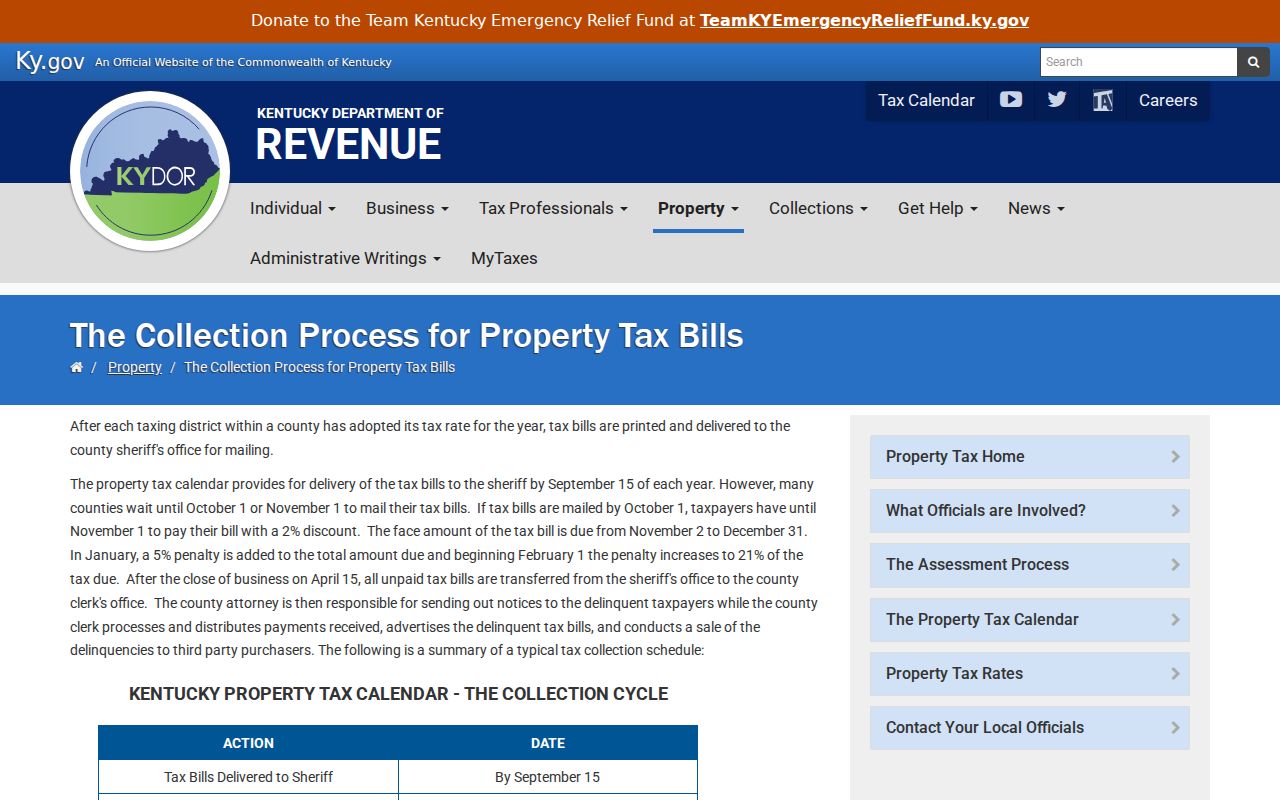
Statewide timing orients your calendar. But the current Casey notice and the local office confirm where a specific bill actually stands.
Casey's January 1 Owner Rule
A Kentucky tax bill names one owner. That is the January 1 owner for the assessment year. A deed recorded later can put a new grantee in the land records. But the bill may still name the former owner. That gap is ordinary timing. It does not mean either record is wrong.
Save the assessment year and the deed recording date side by side. Use the bill for the tax-year obligation. Then use the newest recorded deed for the later conveyance. The PVA revalues every year and adds new construction annually. Each parcel also gets a physical inspection at least once every four years.
Casey Homestead Exemption Records
Kentucky's homestead exemption is $49,100 for 2025 and 2026. State materials set a December 31 application deadline for the year the exemption is sought. The PVA handles eligibility and applications. A qualifying owner should confirm current forms and proof requirements directly with that office.
An exemption flag is useful tax context. It is not proof of daily occupancy, and it is not a deed type. Keep the gross assessment, the exemption amount, and the resulting taxable value separate. Compare years with those three figures kept apart.
Casey's 2026 Delinquent Tax Notice
Casey County's delinquent tax sale follows a published schedule. The Casey Clerk delinquent-tax page set the sale of 2025 delinquent bills for August 14, 2026 at 9:00 a.m. The location was the clerk's office. Treat the notice as a dated event record rather than a live status report. Results do not appear there.
The list itself carries plenty of detail. Entries can show the bill number, name on the certificate, and amount due. They can also show prior certificate year and bill number, prior book/page, and an account or parcel ID. Priority material may add an address and map ID. Buyers were told to research bankruptcy and certificate details. Sales were final with no refunds. A purchased certificate creates a lien interest. It does not instantly make the purchaser the deed owner of record.
Liberty's Rate Uses Casey Values
Liberty Ordinance 25-O-07 sets an FY 2025-26 city ad valorem rate of 0.190 per $100 of assessed value. Real and personal property inside the city both pay it. The assessed base comes from the Casey PVA. That single figure blends nothing else, though. City, county, school, state, and special-district levies are separate components and should stay separate in any Casey County property records comparison.
Treat the rate carefully. It is not a city appraisal ratio. Calling it a market-value percentage without the per-$100 math misstates it. Also confirm the parcel sits inside Liberty before adding city context. A Liberty 42539 mailing address can fall outside the incorporated boundary.
Contest a Casey County Assessment
A Casey County appeal starts with the roll. First inspect it during the statutory window. Then request a conference with the Casey PVA. Kentucky's local appeal form asks for the county, owner, PIDN, land, improvement, and total values, the reason for the appeal, conference facts, supporting evidence, and signatures. Comparable sales, photographs, repair estimates, maps, and a professional appraisal can back the stated issue where they fit.
When a conference settles nothing, the appeal moves through the county clerk to the local board on Kentucky's calendar. No fixed Casey filing date applies every year. The current PVA and clerk notice supplies the live deadline each season.
Use the current appeal window. Contact the Casey PVA and county clerk during roll inspection; do not rely on a prior year's deadline.
Casey Tax Record Access Beyond the Web
Sometimes qPublic, the sheriff channel, and the delinquent page leave a question open. Then request the existing record by parcel and year. Include the situs address and owner of record as shown. Add the parcel or map ID, bill number, certificate year, and the format wanted. Route each question to the right office. The PVA handles assessment fields and corrections. The sheriff handles regular collection. The clerk holds delinquent certificates and sale records.
Kentucky's Open Records Act, KRS 61.870 through 61.884, allows inspection of existing nonexempt records. It also allows standard copies under statutory rules. It never forces an office to build a tax analysis or title opinion. For older research, KDLA lists Casey assessment books in irregular runs. Missing years may need deed books, probate files, and newspaper notices to bridge the gap.
Compare Casey Assessments by Year
Start with clean rows. Copy each year's land, improvement, total, exemption, and owner fields into its own line. Keep the bill year beside the value year with the source date noted. A total can shift for many reasons. New construction, a correction, reclassification, annual revaluation, exemption treatment, or a parcel split can all move it. Never label it a sale increase without a matching recorded deed.
The PVA physically reviews every parcel at least once per four-year cycle. Values are still considered annually. If a property characteristic looks wrong, preserve the screen and contact the PVA. If the owner changed, compare the January 1 snapshot against the newest clerk deed. Do not ask the tax office to amend title.
Casey's Irregular Historic Tax Books
KDLA's inventory shows Casey County tax assessment records surviving in uneven year runs. A blank year is an access or survival gap. It is not proof that a named person owned no land. Search the years on either side. Pair them with deeds, surveys, land entries, probate records, and newspaper legal notices.
Historic tax books can show who was assessed, the general land entry, and shifting valuations. But they cannot stand alone as legal title. Note the volume, year, district or page, exact name form, and adjacent entries each time. Then return to the deed book for the actual conveyance and legal description.